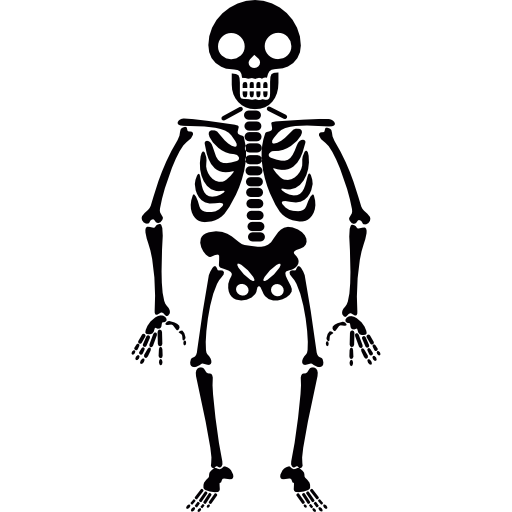
Skeletal System
The rigid framework of 206 bones that supports, protects and enables movement
The Body's Framework
The skeletal system consists of bones, cartilage, ligaments and joints. It forms the structural scaffold for the body, protects vital organs, enables locomotion through muscle attachment, produces blood cells in red marrow and serves as a mineral reservoir for calcium and phosphorus.
Axial vs Appendicular
- Axial (80): Skull 22 + Vertebrae 26 + Thorax 25 + Hyoid 1 + Ossicles 6
- Appendicular (126): Upper limbs 64 + Lower limbs 62
- Pectoral girdle: Clavicle + Scapula (×2)
- Pelvic girdle: 2 hip bones (ilium + ischium + pubis)
- Longest bone: Femur (~48 cm adult male)
- Smallest bone: Stapes (3 mm, middle ear)
Types of Bones
- Long: Femur, humerus, tibia — shaft + epiphyses
- Short: Carpals, tarsals — cube-shaped
- Flat: Skull, sternum, scapula, ribs — protect organs
- Irregular: Vertebrae, facial bones
- Sesamoid: Patella (largest), pisiform — within tendons
- Pneumatic: Frontal, maxilla — air sinuses, reduce weight
Bone Cells
- Osteoblasts: Form bone; secrete osteoid; ALP marker
- Osteocytes: Maintain matrix; in lacunae; mechanosensing
- Osteoclasts: Resorb bone; multinucleated; TRAP+; Howship's lacunae
- Matrix: 65% inorganic (hydroxyapatite) + 35% organic (Type I collagen)
- Haversian canal: Central canal with BVs & nerves; osteon = functional unit
Classification of Joints
- Fibrous: Sutures (skull), syndesmosis, gomphosis — no movement
- Cartilaginous: Synchondrosis (hyaline), symphysis (fibrocartilage)
- Synovial: Hinge (elbow, knee), ball & socket (shoulder, hip), pivot (atlantoaxial), saddle (1st CMC), condyloid (wrist)
- Most mobile: Shoulder (ball & socket)
- Most stable: Hip (deep acetabulum)
Ossification
- Intramembranous: Directly from mesenchyme — flat skull bones
- Endochondral: Replaces cartilage template — all long bones
- First to ossify: Clavicle (5–6 week IU) — both types!
- Distal femur epiphysis: 36 wks IU — confirms term newborn
- CRITOE order: Capitulum→Radial head→Internal epicondyle→Trochlea→Olecranon→External epicondyle
⭐ NEET High-Yield
- Hyoid = only bone not articulating with any other bone
- Wormian bones = intramembranous; seen in OI, hypothyroidism, Down's
- Colles' fracture = distal radius; "dinner fork" deformity; FOOSH
- Most fractured bone = Clavicle
- Largest sesamoid = Patella
- Red marrow in adult: sternum, vertebrae, ribs, iliac crest, proximal femur/humerus
Muscular System
Over 600 muscles enabling movement, posture, heat production and vital organ function
The Body's Engine
The muscular system comprises over 600 named muscles accounting for ~40% of body weight in males. Muscles generate force through contraction, enabling locomotion, maintaining posture, moving substances through the body, stabilising joints and producing heat to maintain body temperature.
3 Types of Muscle
- Skeletal (striated voluntary): Multinucleated, cylindrical. Attached to bone by tendons. Voluntary control. Fast & slow twitch fibres.
- Cardiac (striated involuntary): Branched, single nucleus, intercalated discs with gap junctions. Autorhythmic. Only in heart.
- Smooth (non-striated involuntary): Spindle-shaped, single nucleus. GIT, vessels, uterus. Slow, sustained contractions.
Muscle Microanatomy
- Sarcomere: Functional unit; Z-disc to Z-disc; contains actin (thin) & myosin (thick) filaments
- A-band: Dark band; myosin + actin overlap; does NOT shorten during contraction
- I-band: Light band; only actin; SHORTENS during contraction
- H-zone: Myosin only; narrows during contraction
- Z-line: Anchor for actin; moves closer during contraction
- M-line: Centre of sarcomere; anchors myosin
Sliding Filament Theory
- Step 1: Nerve impulse → ACh released at NMJ → end plate potential
- Step 2: AP propagates along sarcolemma → T-tubules → SR
- Step 3: Ca²⁺ released from SR → binds troponin C
- Step 4: Tropomyosin shifts → exposes actin binding sites
- Step 5: Myosin heads bind actin → cross-bridge cycling (power stroke)
- Step 6: ATP hydrolysis detaches myosin head; cycle repeats
Muscle Fibre Types
| Property | Type I (Slow) | Type II (Fast) |
|---|---|---|
| Colour | Red | White/Pink |
| Myoglobin | High | Low |
| Metabolism | Oxidative (aerobic) | Glycolytic (anaerobic) |
| Fatigue | Resistant | Fatigable |
| Power | Low force | High force |
| Example | Postural muscles | Sprinting muscles |
Connective Tissue Wrappings
- Epimysium: Outermost; surrounds entire muscle belly
- Perimysium: Surrounds fascicles (bundles of fibres)
- Endomysium: Surrounds individual muscle fibres
- Tendon: Dense regular CT; collagen; muscle → bone
- Aponeurosis: Flat sheet tendon (e.g. abdominal wall)
- Fascia: Deep fascia separates muscle compartments
⭐ NEET High-Yield
- Rigor mortis — due to ATP depletion; cross-bridges stay locked; appears 2–6 hrs after death
- Largest muscle = Gluteus maximus; Strongest = Masseter
- Longest muscle = Sartorius (thigh)
- Smallest muscle = Stapedius (middle ear)
- Only A-band width remains constant during contraction
- Myasthenia gravis = autoAb against Ach receptors at NMJ → muscle weakness

Nervous System
The master control system with 86 billion neurons regulating every body function
The Master Control Centre
The nervous system is the body's electrical communication network. It detects changes in the internal and external environment, processes this information, and coordinates responses to maintain homeostasis. It controls everything from heartbeat and breathing to thought, emotion and movement.
Organisation of NS
- CNS: Brain + Spinal cord — processing centre
- PNS: All nerves outside CNS — 12 cranial + 31 spinal nerve pairs
- Somatic NS: Voluntary; skeletal muscle; single neuron to effector
- Autonomic NS: Involuntary; viscera; 2-neuron pathway (preganglionic + postganglionic)
- Sympathetic: "Fight or flight" — T1–L2; noradrenaline
- Parasympathetic: "Rest & digest" — CN III,VII,IX,X + S2–S4; acetylcholine
The Neuron
- Dendrites: Receive signals → cell body
- Cell body (soma): Contains nucleus; Nissl bodies (rER) for protein synthesis
- Axon hillock: Trigger zone — initiates action potential
- Axon: Transmits AP away from soma; myelinated or unmyelinated
- Myelin sheath: Schwann cells (PNS), oligodendrocytes (CNS) — speeds conduction
- Nodes of Ranvier: Gaps in myelin → saltatory conduction
Action Potential
- Resting potential: –70 mV; maintained by Na⁺/K⁺ ATPase (3 Na⁺ out, 2 K⁺ in)
- Depolarisation: Na⁺ rushes in → membrane reaches +30 mV
- Repolarisation: K⁺ rushes out → returns to –70 mV
- Hyperpolarisation: Briefly more negative than –70 mV (refractory period)
- All-or-none law: AP fires completely or not at all
- Saltatory conduction: AP jumps node to node → faster; uses less ATP
Brain Regions & Functions
- Cerebrum: Voluntary movement, sensation, speech, memory, personality — 4 lobes
- Frontal lobe: Motor cortex (primary), Broca's area (speech production)
- Temporal lobe: Hearing, Wernicke's area (speech comprehension), memory
- Cerebellum: Coordination, balance, fine motor control; "little brain"
- Hypothalamus: Master of ANS; temperature, hunger, thirst, circadian rhythm
- Medulla oblongata: Vital centres — cardiac, respiratory, vasomotor
Glial Cells (Neuroglia)
- Astrocytes: Blood-brain barrier support; metabolic support for neurons; most abundant CNS glial cell
- Oligodendrocytes: Myelin in CNS (one cell myelinates multiple axons)
- Schwann cells: Myelin in PNS (one cell per segment); allow nerve regeneration
- Microglia: CNS macrophages — immune defence
- Ependymal cells: Line ventricles; produce CSF
⭐ NEET High-Yield
- Broca's area (L frontal) = motor speech; Wernicke's (L temporal) = comprehension
- Largest cranial nerve = CN V (trigeminal); only motor = CN XI (accessory)
- Blood-brain barrier = tight junctions of endothelium + astrocyte endfeet
- Meninges: Dura → Arachnoid → Pia mater (D-A-P)
- CSF produced in choroid plexus; total ~150 mL; reabsorbed at arachnoid granulations
- Parkinson's = dopamine ↓ (substantia nigra); Alzheimer's = Ach ↓ + amyloid plaques
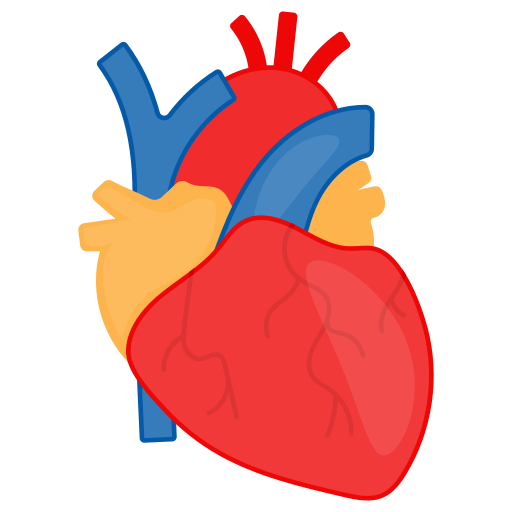
Cardiovascular System
The heart and ~100,000 km of blood vessels delivering oxygen and nutrients to every cell
The Body's Transport Network
The cardiovascular system consists of the heart (pump), blood vessels (conduits) and blood (transport medium). It circulates approximately 5 litres of blood per minute at rest, delivering O₂ and nutrients, removing CO₂ and waste products, regulating temperature, pH and distributing hormones throughout the body.
Heart Anatomy
- Location: Mediastinum; 2/3 left of midline; T5–T8 level
- Size: ~12 cm long, 9 cm wide; weight ~300 g
- Pericardium: Fibrous (outer) + serous (parietal + visceral/epicardium)
- Wall layers: Epicardium → Myocardium (cardiac muscle) → Endocardium
- 4 chambers: RA, LA (atria — thin walls) + RV, LV (ventricles — thick walls)
- LV wall: 3× thicker than RV (pumps to systemic circulation)
Cardiac Valves
- Tricuspid: RA → RV; 3 cusps; at 4th–5th ICS, right of sternum
- Pulmonary: RV → Pulmonary trunk; semilunar; 2nd ICS, left of sternum
- Mitral (Bicuspid): LA → LV; 2 cusps; 4th–5th ICS, mid-clavicular line
- Aortic: LV → Aorta; semilunar; 2nd ICS, right of sternum
- Mnemonic: "Try Pulling My Aorta" (T→P→M→A, right to left)
- Auscultation: Apex beat = 5th ICS, MCL (mitral valve best heard here)
Cardiac Conduction System
- SA node: Pacemaker; RA near SVC; fires 60–100/min; sets heart rate
- AV node: RA-RV junction; delays impulse (0.1 sec) → allows atrial fill
- Bundle of His: Through interventricular septum → splits L+R bundle branches
- Purkinje fibres: Spread through ventricular myocardium; fast conduction
- Intrinsic rates: SA 60–100, AV 40–60, Purkinje 20–40 bpm
- ECG: P-wave = atrial depolarisation; QRS = ventricular depolarisation; T = ventricular repolarisation
Cardiac Physiology
- Cardiac Output (CO): CO = Heart Rate × Stroke Volume (normal: 5 L/min)
- Stroke Volume: Volume ejected per beat (~70 mL at rest)
- Ejection Fraction: SV/EDV × 100 = ~60–70% (normal ≥55%)
- Starling's Law: Greater preload (stretch) → greater force of contraction
- Preload: EDV; Afterload: aortic pressure against which LV must pump
- Blood pressure: Normal = <120/80 mmHg; BP = CO × Total Peripheral Resistance
Blood Vessels
- Arteries: Away from heart; thick tunica media; resist high pressure; elastic + muscular types
- Arterioles: Major resistance vessels; regulate BP and blood flow distribution
- Capillaries: Site of exchange; only tunica intima (1 cell thick); 1 RBC at a time
- Venules → Veins: Toward heart; thin walls; large lumen; valves prevent backflow
- Capacitance vessels: Veins hold ~64% of blood volume
- Portal circulation: Hepatic portal vein: gut → liver → IVC (unique double capillary bed)
⭐ NEET High-Yield
- Pulmonary circulation carries deoxygenated blood in pulmonary arteries (exception to rule!)
- Coronary arteries fill during diastole (heart relaxed)
- RCA supplies SA node (60%), AV node (80–90%) — heart block in RCA occlusion
- Widowmaker = left anterior descending (LAD) artery occlusion → anterior MI
- Heart sounds: S1 (lub) = AV valves close; S2 (dub) = semilunar valves close
- Pericarditis = friction rub; Cardiac tamponade = Beck's triad (↓BP + ↑JVP + muffled heart sounds)